
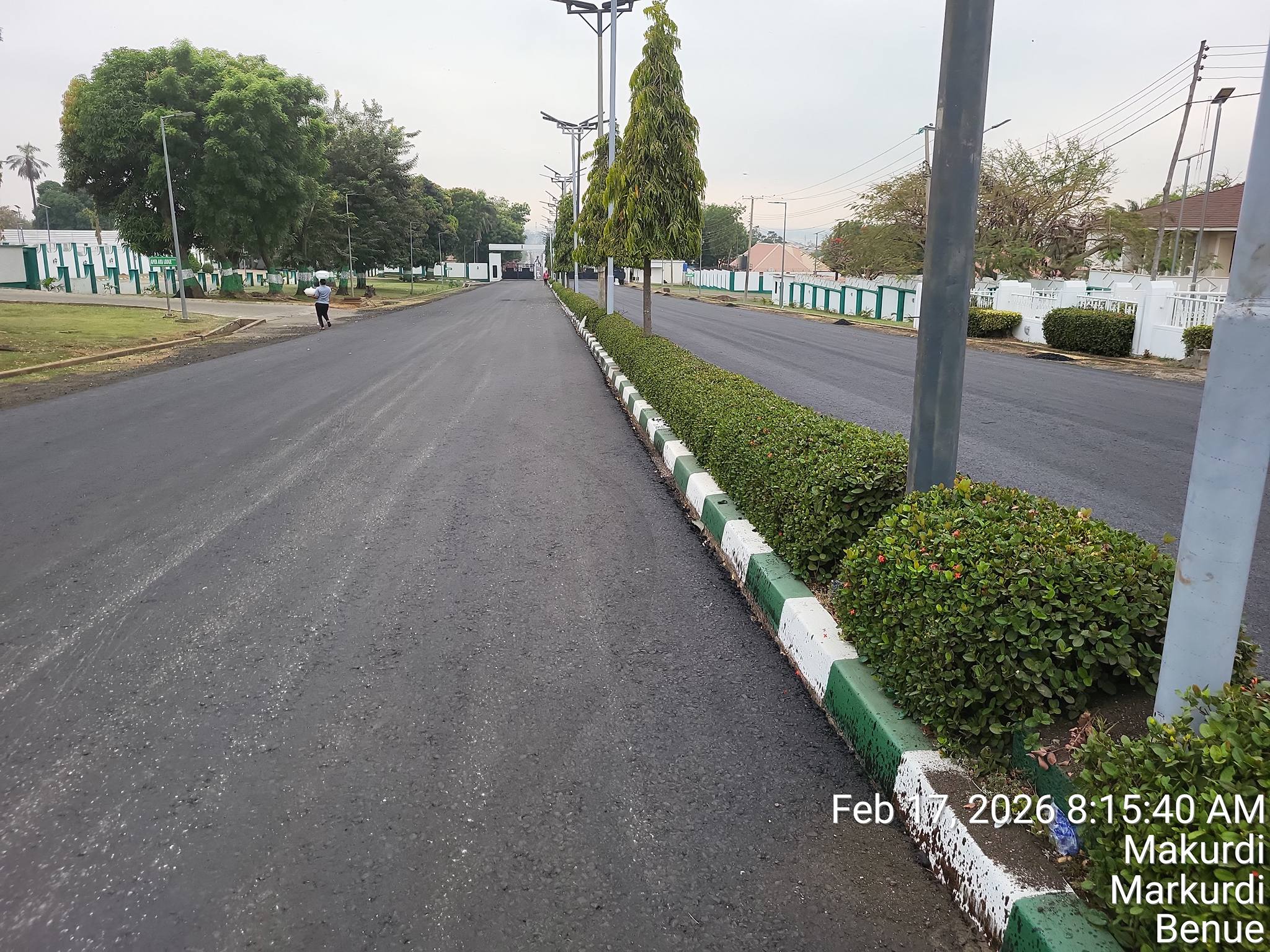
The commencement of asphalting works on the Benue State Government House Road in Makurdi marks a significant milestone in the infrastructural development agenda of the Benue State Government under the leadership of Hyacinth Alia. This important project underscores the administration’s commitment to urban renewal, improved mobility, and the restoration of public confidence through visible and impactful governance. As the capital city of Benue State, Makurdi occupies a central position in administration, commerce, and social life, making the condition of its key roads a matter of public importance.
The Government House Road is one of the most prominent roads in Makurdi, serving as the main access route to the seat of government. It connects the Government House complex with other major parts of the city and is used daily by government officials, civil servants, residents, and visitors. Over time, the road had suffered considerable deterioration due to heavy traffic, erosion, and years of inadequate maintenance. Potholes, uneven surfaces, and poor drainage had become common, causing inconvenience and safety concerns for road users. The decision to asphalt this road therefore represents a timely and deliberate response to a long-standing infrastructural challenge.
From the beginning of his administration, Governor Alia emphasized infrastructure as a key driver of development. Roads, in particular, were identified as critical to economic growth, security, and social cohesion. The asphalting of the Government House Road aligns with this broader vision, reflecting a practical approach to governance that prioritizes functionality, durability, and value for public resources. Rather than temporary repairs, the project focuses on comprehensive rehabilitation designed to deliver long-term benefits.
The scope of the work includes proper earthworks, drainage improvement, base preparation, and the laying of high-quality asphalt surfacing. These technical elements are essential to ensuring that the road can withstand heavy usage and adverse weather conditions. By incorporating effective drainage systems, the project also addresses one of the major causes of road failure in urban areas—water damage—thereby enhancing the lifespan of the infrastructure.
Beyond improving access to the Government House, the project has wider implications for Makurdi’s urban development. Good road infrastructure facilitates movement, reduces travel time, lowers vehicle maintenance costs, and improves overall productivity. For residents living and working around the Government House area, the improved road translates into safer, smoother, and more comfortable commuting. For visitors and investors, it presents a positive image of a state capital that is orderly, functional, and development-oriented.
The economic impact of the project is also noteworthy. Road construction activities create employment opportunities for both skilled and unskilled workers, while the procurement of materials and services stimulates local businesses. Food vendors, transport operators, and suppliers benefit from increased economic activity around the construction site. Although these benefits may seem indirect, they contribute meaningfully to livelihoods and local economic circulation.
Symbolically, the choice to begin with the Government House Road carries strong significance. It reflects the philosophy that governance should start with putting critical public assets in order. A well-maintained access road to the seat of power sends a message of seriousness, discipline, and accountability. It also sets a standard for other road projects across the state, reinforcing the expectation that public infrastructure should meet acceptable quality and durability benchmarks.
Public reaction to the commencement of the asphalting has been largely positive. Many residents see it as a clear sign that government promises are being translated into concrete action. Civil servants and daily commuters, in particular, have expressed optimism that the improved road will ease movement and reduce the stress associated with navigating a deteriorated roadway. Such responses highlight the importance of visible infrastructure projects in strengthening trust between the government and the people.
The Government House Road project fits into a broader pattern of infrastructural interventions across Benue State. The Alia administration has consistently signaled its intention to open up urban and rural areas through improved road networks, recognizing that connectivity is essential for commerce, agriculture, and social interaction. While this particular project is urban-focused, it symbolizes a wider commitment to linking communities and supporting economic activities across the state.
Security considerations also form part of the project’s importance. Well-constructed roads enhance visibility, improve access for security patrols, and reduce risks associated with poorly maintained routes. In and around sensitive government facilities such as the Government House, quality road infrastructure contributes to a safer and more controlled environment.
Environmental factors have likewise been taken into account. Proper drainage channels help manage stormwater and reduce erosion, minimizing negative environmental impact and preventing premature road damage. By addressing these issues at the construction stage, the project reflects a growing emphasis on sustainable infrastructure development within the state.
As work progresses, expectations are high that the completed road will significantly improve the outlook of the Government House area. The smooth asphalt surface will reduce dust, noise, and travel discomfort, contributing to a cleaner and more organized urban environment. Over time, improved infrastructure is also likely to attract further public and private investments in the vicinity, enhancing property values and commercial activity.
In conclusion, the asphalting of the Benue State Government House Road in Makurdi represents more than a routine public works project. It is a strategic intervention that addresses a critical infrastructural need, improves mobility and safety, stimulates economic activity, and reinforces standards of quality in public service delivery. Under the leadership of Governor Hyacinth Alia, the project stands as a visible expression of purposeful governance and a step forward in the ongoing effort to build a modern, functional, and development-driven Benue State.
Leave a Reply